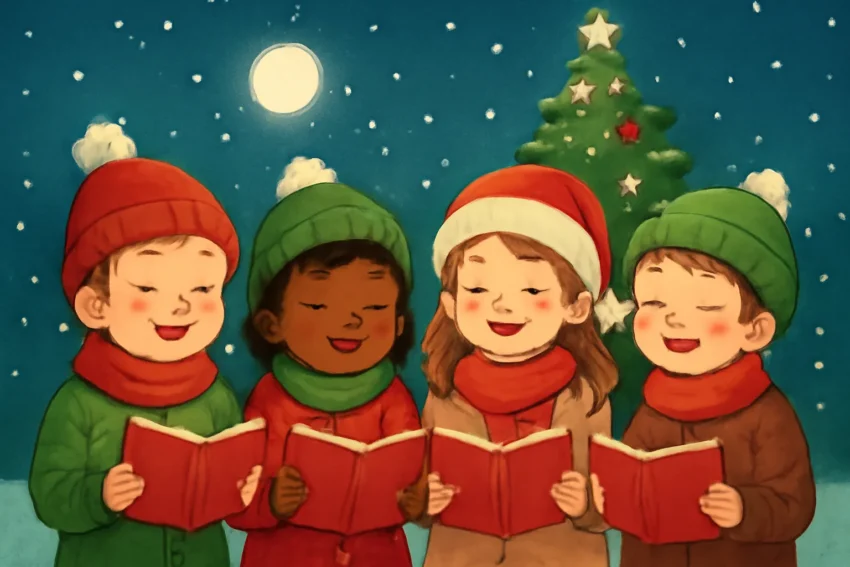
Introduction: The Power and Joy of Childrens Christmas Carols
Childrens Christmas Carols: Timeless Songs for Kids and Families is more than a seasonal playlist. It is a cultural bridge that connects generations, a musical rhythm that invites children to participate, imagine, and learn through song. Across cultures and continents, these carols carry stories of family, generosity, wonder, and the magic of the winter season. They are often designed to be inclusive, singable, and memorable, with melodies that linger in memory long after the last note has faded. For families, school communities, and community choirs, these songs offer a way to celebrate together, to introduce basic musical concepts, and to build shared memories that endure beyond December.
In this article, we explore the history, variety, and educational value of child-centered Christmas songs. We examine how traditional tunes with simple melodies can be reimagined for modern classrooms and homes, and we discuss practical ways to organize, teach, and enjoy caroling with children of different ages and backgrounds. Whether you are a parent guiding a family sing-along, a teacher planning winter activities, or a community organizer coordinating a festive program, this guide will help you select songs, adapt them for accessibility, and design activities that amplify joy, learning, and togetherness.
Why Children Love Christmas Carols: What Makes a Song for Kids Timeless
The charm of child-centered Christmas carols lies in their clarity, repetition, and warmth. A good carol for kids typically features:
Simple melodies that are easy to learn by ear and quick to pick up for first-time singers.
Relatable themes—visions of animals, stars, gifts, snow, cookies, and family togetherness—that speak directly to children’s experiences.
Repetition of phrases or structures that build confidence and fluency as children sing.
Call-and-response patterns, which invite active participation from the youngest members without requiring extensive musical training.
Inclusive language and imagery that can be embraced by diverse audiences and translated for multilingual settings.
Beyond entertainment, these carols can foster early literacy (through lyrics), rhythm sense (through clapping and moving to tempo), and social-emotional skills (through sharing, listening, and cooperation). The educational potential of carols is broad: they support pronunciation and phonemic awareness, introduce basic musical terms, and provide a structured context for performing arts experiences that reinforce memory and confidence.
As you explore different carols, you will notice that variations exist across regions and languages. Some songs have centuries-old roots, while others have been composed in recent decades to speak to modern families. The variety itself is a resource: it allows educators and families to tailor material to age groups, cultural backgrounds, and linguistic needs.
Historical Roots: How Childrens Christmas Carols Emerged
The landscape of Christmas carols, including those aimed at children, has evolved over many centuries. While you might think of carols as purely medieval or Victorian, the repertoire actually spans dozens of eras and continents. Traditional carols often grew out of local church music, seasonal folk songs, and oral storytelling traditions. When sung by children, these melodies take on a new life—becoming a shared language that passes from one generation to the next.
Early Roots and Public Domain Treasures
A substantial portion of classic children’s carols come from the public domain tradition. These songs are valuable for schools and families because they can be reproduced and performed without copyright concerns. Songs like The Holly and the Ivy, We Three Kings, O Little Town of Bethlehem, and The First Noel have long, straightforward melodies that are ideal for teaching young voices. They also provide historical context for kids who are curious about how Christmas music has changed over centuries.
In the 20th and 21st centuries, composers and lyricists created carols that resonated with contemporary families. You may encounter songs with playful, narrative storytelling, or tunes designed specifically for school performance contexts. Modern family-friendly carols often emphasize storytelling, imagination, and social joy—elements that children naturally respond to. This blend of heritage tunes and new creations expands the repertoire without sacrificing the accessible qualities that make carols suitable for kids.
Categories of Carols for Kids: Traditional, Modern, Multilingual, and Interactive
Traditional Public-Domain Melodies
Traditional carols provide a robust foundation for children’s singing. They typically feature:
Simple call-and-response sections that teachers can use to involve every child.
Repetition of a few short verses, which helps with memorization and pronunciation.
Conventional keys and moderate tempo, making them accessible to early readers and beginner singers.
Examples of traditional, kid-friendly carols include:
The First Noel — a narrative carol with clear, memorable imagery
Jingle Bells — a busier melody but very catchy and universally recognized
We Wish You a Merry Christmas — an upbeat, inclusive chorus suitable for group singing
Deck the Halls — a festive tune that encourages participation through rhythm and repetition
Rudolph the Red-Nosed Reindeer — though later than medieval carols, it has a simple chorus perfect for kids
Modern Compositions for Young Voices
Modern carols or contemporary Christmas songs are crafted with today’s classrooms in mind. They often feature:
Short verses and a refrain that children can memorize quickly
Less complex harmony and a focus on melody and rhythm that are easy to follow
Engaging themes such as family togetherness, giving, and wonder at night skies and snowy landscapes
Examples of kid-friendly modern carols or winter songs include A Starry Night, Snowflake Parade, and Brightest Star. These pieces often incorporate simple sign-language gestures, body percussion, or call-and-response forms that welcome even the youngest children to participate.
Multilingual and Culturally Diverse Carols
Christmas carols are a global phenomenon. Many families celebrate with songs in multiple languages, and schools increasingly expose students to this multilingual richness. Multilingual carols may be:
Translations of traditional tunes that preserve the melody while adapting the words
Original songs written in languages other than English with familiar structures for children
Collaborative performances where students bring their own linguistic traditions into the concert space
Engaging with multilingual carols not only builds linguistic awareness, but it also fosters respect for cultural diversity and expands the sense of inclusivity within a family or classroom setting.
Interactive and Participatory Formats
Not all carols must be performed as a solo or a formal concert piece. Interactive formats invite participation and can be especially valuable for younger children. Some effective formats include:
Rhythmic clapping and stepping patterns aligned to the beat
Simple sign language or hand motions to accompany lyrics
Call-and-response games where a leader sings a line and the group echoes
Miniatures of a music theater style, with kids acting out a short scene while a carol plays softly in the background
These formats help maintain attention, reinforce memory, and build confidence in shy or reserved children. They also make performances more dynamic and inclusive.
Educational Benefits of Singing Carols with Children
Beyond holiday cheer, singing carols provides a platform for early music education and social development. Here are some of the core benefits:
Phonological awareness — recognizing sounds, syllables, and word boundaries through lyric practice.
Rhythm and tempo — tapping or clapping helps children internalize beat and meter.
Melodic memory — melodies with simple contours are easier to memorize, aiding recall of lyrics and sequences.
Language skills — pronunciation, vocabulary, and expressive phrasing improve with repeated practice.
Literacy connections — reading lyrics, marking lyrics on paper, and following along with written text reinforce literacy development.
Social-emotional learning — singing together builds empathy, cooperation, and a sense of belonging in a group.
Cultural awareness — exposure to different carols fosters respect for diverse traditions and languages.
For teachers and parents, structuring these benefits into manageable activities can maximize outcomes. Short practice sessions, clearly defined goals, and a routine that allows every child a chance to participate are essential components of an effective carol program.
Practical Guidelines: Selecting and Adapting Carols for Home and School
When choosing songs for children, consider age appropriateness, vocal range, and cultural relevance. The following guidelines can help you assemble a practical, enjoyable repertoire.
Assess the age group — Younger children benefit from very simple melodies and fewer lines; older children can handle short verses and more energetic tunes.
Match vocal range — Choose songs that sit within a comfortable range for children’s voices. If your group spans a wide range, select songs with optional higher or lower parts.
Favor short forms — Refrains and repeated choruses help kids remember and perform with confidence.
Plan for accommodations — Provide lyrics in large print, offer audio recordings, and consider sign language or visual cues for non-readers.
Encourage repeated exposure — Short practice sessions across several days build fluency more effectively than one long session.
Integrate movement — Simple hand motions, body percussion, or prop use can enhance engagement and help memory.
Highlight inclusivity — Choose songs that allow children from various backgrounds to see themselves in the music and lyrics, or provide translations when possible.
In homes, you can adapt a carol for family evenings by pairing singing with a small activity, such as decorating cookies while listening to the music, or using a “carol corner” where kids practice a new song a few minutes each night. In classrooms, teachers can structure a mini-residency around a few core carols, culminating in a small showcase or a simple sing-along for families.
Tips for Teaching and Rehearsing
Start with a demo recording or a live demonstration of the song and sing along.
Introduce words and meaning before music—talk about the story or image in the lyric.
Use visual aids such as lyric projections, flashcards, or picture cues.
Offer silent practice for the tricky lines, then gradually add music.
End sessions with a short circle time to celebrate progress and reinforce a sense of community.
Global Perspectives: Carols in Languages Beyond English
The Christmas season is celebrated around the world, and many families enjoy carols in languages other than English. Global carols bring a richness of melody, rhythm, and storytelling that can broaden children’s musical horizons. For families and classrooms that value cultural exchange, exploring carols in languages such as Spanish, French, German, Italian, Polish, Portuguese, Swedish, Finnish, Gaelic, and dozens of other tongues can be both educational and deeply rewarding.
When integrating multilingual carols, consider these approaches:
Simplified lyric sheets with phonetic guides to support pronunciation.
Language rotation where small groups take turns presenting lines in different languages.
Translation notes that explain imagery, idioms, and cultural references.
Peer support pairing native speakers with learners to model proper intonation and phrasing.
Multilingual carols can become a focal point for community events, linking families who speak different languages at home with shared celebrations. They also offer a chance for children to see how music can cross linguistic boundaries and create a sense of unity.
Song Selection: A Curated Starter List for Different Settings
Below is a starter list of child-friendly carols and winter songs categorized by setting and purpose. Use this as a practical starting point to build a repertoire that resonates with your group.
Public domain classics for school concerts: The First Noel, We Three Kings, Deck the Halls, Jingle Bells, Good King Wenceslas (if appropriate for your region).
Gentle, story-driven tunes for circle time: Silent Night, Away in a Manger, It Came Upon the Midnight Clear.
Upbeat group pieces for recess or assembly: We Wish You a Merry Christmas, Up on the Housetop, The Christmas Song (Chestnuts Roasting) in a child-friendly arrangement.
Multilingual options for diverse classrooms: O Tannenbaum in different languages, Feliz Navidad in bilingual or translated versions, Alle Jahre Wieder (adapted for a multilingual audience).
Modern compositions focused on storytelling and empathy: A Starry Night, Brightest Star, Snowflake Parade (titles may vary by location).
When shaping a season-long program, aim for a balanced mix of carols that appeals to different senses—one that tells a tale, one that invites audience call-and-response, one that allows quiet reflection, and one that energizes a festive crowd. A thoughtful sequence can help children build confidence as they progress from simple chorus songs to slightly longer verses.
Performance Ethics: Respect, Inclusion, and Accessibility
A successful carol program is built on respect and accessibility. Here are key considerations to ensure that performances honor all participants:
Respect for sources — acknowledge the origins of songs and provide context when appropriate, especially for culturally specific melodies.
Inclusion of all voices — ensure that every child has an entry point, whether through chorus, a bell or percussion part, or a sign-language cue.
Accessibility — provide large-print lyric sheets, captions, or screen-readable formats; consider audio descriptions for children with visual impairments.
Adaptability — be prepared to simplify verses or adjust tempo for different abilities without diminishing the spirit of the carol.
Family engagement — invite families to participate in a casual carol night, which strengthens school-community ties and broadens the sense of shared celebration.
Building a Carols Library: Practical Tools and Resources
A well-curated library of child-friendly Christmas carols can be a valuable resource for families, teachers, and youth groups. Here are practical steps to build and maintain a robust collection:
Catalog songs by tier — separate songs by difficulty (level 1: very simple; level 2: simple with optional harmony; level 3: longer or more complex but still child-appropriate).
Include varied formats — printed lyric sheets, simple lead sheets, audio recordings, and instrumental tracks that can accompany singing.
Backup plans — maintain a set of backup songs that can be substituted if participation levels are low or if some children are absent.
Seasonal rotation — rotate a portion of the repertoire every year while preserving a core set that children recognize and enjoy.
Accessibility notes — keep a separate folder of simplified lyrics, phonetic guides, and translations for languages spoken by members of the community.
If you are looking for sources, consider public-domain songbooks, school-friendly anthologies, and reputable music education resources. For families, a simple USB drive or cloud folder with audio tracks and printable lyrics can be a practical starter kit.
Creative Extensions: Activities to Enrich the Carols Experience
Turning carols into an immersive learning experience can deepen engagement and memory. Here are creative ideas to enrich a carol-focused program:
Story corners — have a short narrative adaptation of a carol’s theme before singing.
Art and craft integration — create simple decorations inspired by a carol’s imagery (stars, trees, bells, winter landscapes).
Movement and dance — incorporate simple steps or dancing motions aligned to tempo and mood.
Instrumental accompaniments — provide easy percussion options (shakers, tambourines, small drums) to involve more students in the performance.
Parade-style performance — a micro-performance in a hallway or outdoor corridor to bring carols to a broader audience within a school or neighborhood.
These extensions not only make the carol experience more dynamic but also help children connect musical skills to broader creative practice.
Conclusion: The Enduring Value of Childrens Christmas Carols
The enduring appeal of Childrens Christmas Carols: Timeless Songs for Kids and Families lies in their ability to combine joyful sound with meaningful storytelling, all while nurturing musical literacy and community spirit. These songs are a shared cultural resource that can adapt to changing times—whether sung in church halls, classrooms, living rooms, or community centers. They can be gateways to musical exploration, language learning, and cross-cultural understanding.
By selecting a varied repertoire, teaching with clarity, and inviting broad participation, educators and families can ensure that carols remain relevant and inclusive for generations to come. The season gives us a chance to come together, to learn from one another, and to celebrate the magic of winter with songs that welcome every child into the circle of song.
As you embark on your own carol journey, remember that the best carols for children are those that invite participation, spark imagination, and leave a warm feeling of belonging long after the final note. Whether your tradition favors time-honored classics, contemporary arrangements, or bilingual performances, the true holiday harmony comes from the joy of singing together as a family, a class, and a community.