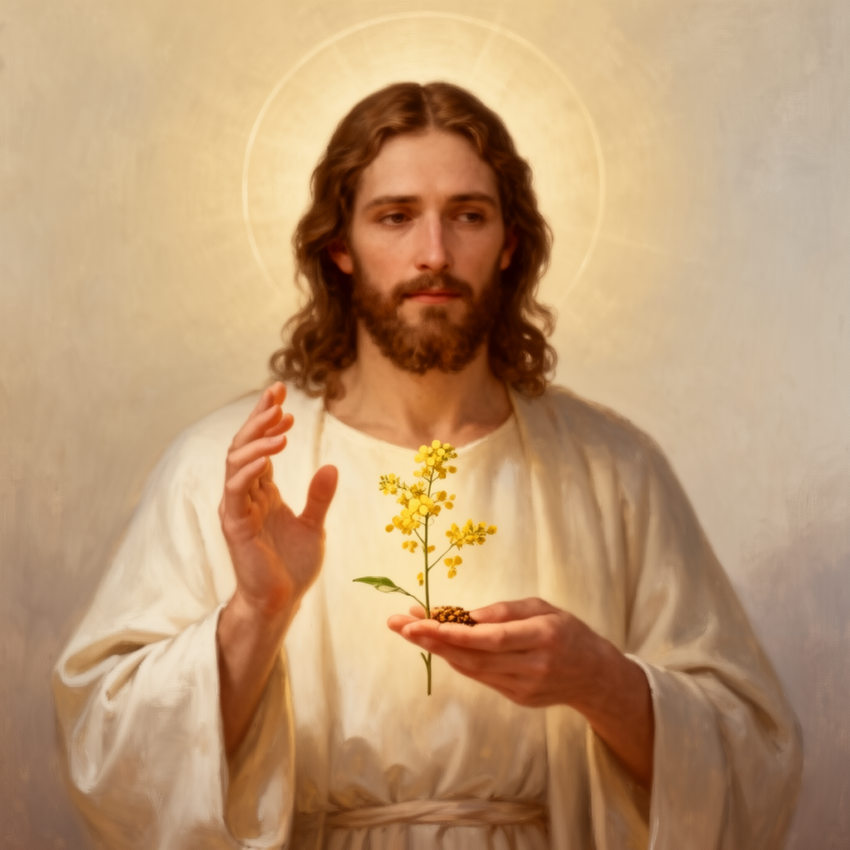
The mustard plant is an annual or biennial herb ranging from 1 to 2 meters tall. It features bright green, lobed or pinnate leaves with a pungent, spicy aroma. During flowering, it produces small, four-petaled yellow flowers, clustered tightly in cymes. Its seed pods are capsule-like, containing tiny round seeds that vary in color from black (Brassica nigra), white (Sinapis alba), to brown (Brassica juncea). The plant prefers temperate climates, thriving in well-drained soils with full sun. It is cultivated widely for its seeds, which are ground into mustard condiment, and the plant's rapid growth and resilience have made it a staple in ancient agriculture.
Scientific Name
Brassica nigra (most widely accepted candidate), with alternatives including Sinapis alba or Brassica juncea
Native to the Mediterranean region and Near East, mustard plants grow naturally in sunny, well-drained soils. Historically, they thrived in plains, foothills, and cultivated fields across Israel, Lebanon, Syria, and surrounding areas, adapting well to Mediterranean climate conditions with wet winters and hot, dry summers.
First Biblical Mention
Matthew 13:31, in the parable of the mustard seed, signifying small beginnings and great outcomes
Jesus compares the kingdom of heaven to a mustard seed, which is the smallest of all seeds but grows into a large tree.
This illustrates the exponential growth of God’s kingdom from humble beginnings to a global force, emphasizing faith and divine potential.
Mark 4:30-32
Similar parable of the mustard seed’s growth in the context of faith and the kingdom of God.
Highlights the transformative power of small acts of faith and the expansive reach of God’s kingdom.
✨ Symbolic Meaning in Scripture
The mustard seed symbolizes the potential inherent in small beginnings, faith, and the invisible growth of the Kingdom of God. Its small size contrasts with its remarkable towering growth, representing how humble faith or acts can lead to profound spiritual impacts. Throughout Scripture, it emphasizes divine sovereignty in transforming the insignificant into the significant. The seed also embodies the idea of divine mystery and the universality of God's plan, accessible to all regardless of initial stature. As a symbol, it challenges believers to nurture faith from modest starts, trusting in divine growth and the eventual flourishing of God's kingdom amidst adversity and silence.
🏺 Cultural Uses in the Ancient World
Ancient Israelites cultivated mustard plants for their flavorful seeds used in cooking and medicinal remedies. The seeds were ground into mustard paste, a condiment, and the leaves sometimes served as forage. Additionally, the plant's tough branches provided shade or fencing material. Mustard seeds also held symbolic significance in trade and social interactions, representing prosperity and fertility in agriculture. Its quick germination and resilience made it a valued crop in dry, rocky soils, often planted alongside other grains. Medicinally, mustard seeds were used to treat respiratory issues, digestive problems, and rheumatism, demonstrating their integral role in traditional Near Eastern medicine.
✡️ In Jewish Tradition
In Jewish culture, mustard seeds symbolize faith and humility. The concept appears in rabbinic literature as an example of small beginnings leading to great outcomes, reinforcing trust in divine providence. Although not a major ritual plant, some traditions associate mustard with abundance and prosperity, as its small seeds symbolize potential and growth. The parable of the mustard seed contributes to teachings that emphasize the importance of maintaining faith despite modest starts, and it occasionally appears in Midrashic discussions about the growth of God's word and community.
Christianity interprets the mustard seed as a metaphor for faith, emphasizing that even the smallest faith can lead to great spiritual transformation. It underscores the concept of divine growth from humble beginnings, inspiring believers to trust in God's transformative power. The plant's image is often used in sermons and religious art to illustrate how God's kingdom expands silently but surely, from insignificant origins to a mighty spiritual force. It encourages believers to nurture their faith and recognize the potential for greatness embedded in small acts of devotion or belief.
🔬 Modern Botanical Identification
Most scholars identify the biblical mustard seed with Brassica nigra (black mustard), given its prominence and size, but Sinapis alba (white mustard) and Brassica juncea (brown mustard) are also plausible candidates due to their widespread cultivation and similar seed characteristics. There is no universal consensus, as the biblical descriptions are somewhat general. Some researchers suggest that the term 'mustard seed' could refer broadly to several mustard varieties common in the region.
🗺️ Where Is It Found Today?
Today, mustard plants still grow abundantly in Israel, Lebanon, and surrounding countries, often in wild or cultivated fields. The black and white mustard varieties are common in Mediterranean gardens and farms, thriving in rocky, well-drained soils and full sun, reflecting their ancient origins.
❓ Frequently Asked Questions
Is the mustard seed used today in biblical studies?
Yes, the mustard seed remains a key symbol in biblical theology, representing faith and divine growth, and is often referenced in sermons, religious education, and theological discussions.
Are all mustard plants the same species mentioned in the Bible?
Not necessarily; the biblical term may refer to various mustard varieties like Brassica nigra, Sinapis alba, or Brassica juncea, which share similar seeds but differ botanically.
Why is the mustard seed considered small and yet so significant?
The small size of the seed symbolizes humility and modest beginnings, while its capacity for rapid, expansive growth demonstrates the potential for great spiritual and worldly impact from humble starts.
✨ Did You Know?
Archaeological evidence suggests that mustard seeds were traded and processed in the Ancient Near East over 2,000 years ago. Their small seeds have been found in archaeological sites, indicating their significance in daily life and religious practices during biblical times.