Church Banners: Custom Signage Ideas, Design Tips & Materials
In many congregations, banners are more than decorative accents. They are visual sermons, welcoming tools, and liturgical cues that reinforce the church’s mission, season, and values. When designed and produced with care, church banners can transform spaces—from the vestibule to the sanctuary, from the fellowship hall to the outdoor campus—and they can travel with the community into outreach events, conferences, and mission trips. This article provides an in-depth look at custom signage ideas, design tips, and materials selection for banners that are beautiful, durable, and meaningful.
The role of banners in a church setting
Church banners are multifaceted assets. They serve as:
Guides that help worshippers navigate spaces, especially in large campuses or during events.
Messages that communicate doctrinal themes, seasonal invites, and community goals.
Aesthetics that frame liturgy and create an atmosphere of reverence, celebration, or reflection.
Storytelling tools that visually articulate church history, mission, or outreach narratives.
Fundraising and stewardship aids that recognize donors or solicit contributions for building projects.
Beyond function, banners contribute to the ambience of worship. They can illustrate parables, saints, or biblical motifs in a way that complements preaching and music without distracting from the liturgy. The most effective banners balance clarity with beauty, ensuring that the message remains legible from a distance and resonates with diverse audiences.
Variations of church banners: naming and scope
To cover the breadth of church signage, it helps to think in terms of design categories and placement roles. Here are common variations:
Processional banners carried by acolytes or ministers during processions; often tall, narrow, and highly symbolic.
Altar and sanctuary banners that frame the pulpit, lectern, and altar area; typically fabric-backed with rich colors and intricate embroidery or applique.
Welcome banners placed near entrances or narthex to greet newcomers and set a hospitable tone.
Seasonal banners reflecting Advent, Christmas, Lent, Easter, Pentecost, and other liturgical seasons.
Mission and outreach banners highlighting global or local ministries and partnerships.
Memorial and donor banners acknowledging individuals or families who supported a project or renovation.
Interior banners used in Bible study rooms, youth spaces, or classrooms to reinforce theme or Scripture.
Outdoor banners designed for weather exposure, signage for community events, or welcome messages for visitors at church campuses.
Pew and seating banners that run along aisles or back of chairs, often used for processions or to convey seasonal color cues.
Across settings, designers often mix and match these categories to tell a cohesive story for a given year or event. Variations in fabrics, mounting systems, and production methods enable churches to express identity in both traditional and contemporary voices.
Materials: how to choose for durability, aesthetics, and symbolism
The choice of material has a major impact on durability, appearance, maintenance, and cost. Each category below has its own advantages and considerations for a church environment.
Fabric banners
Fabric banners are among the most classic options for interior settings. They often feature vibrant colors, soft drape, and possibilities for embroidery or applique. Common fabrics include velvet, satin, cotton twill, polyester, and linen blends. For high-traffic areas or more formal spaces, consider:
Polyester with flame retardant treatment for safety and durability.
Velvet or velour for sanctuary elegance and rich texture.
Stretch or mesh fabrics used with backlighting to create luminous effects.
Pros: excellent color depth, tactile depth, and a sense of reverence. Cons: can be heavier, may require more storage, and stitching/embroidery can raise costs.
Vinyl banners
Vinyl is a versatile, economical, and durable option for both interior and exterior banners. It can be printed with high-resolution graphics and is relatively easy to clean. Options include:
Matte vinyl reduces glare in bright spaces.
Gloss vinyl yields vibrant colors for seasonal themes and proclamations.
Block-out vinyl provides opaque backing for legibility when used in front of windows or mixed lighting.
PVC-free or recycled-content vinyl for churches prioritizing sustainability.
Pros: weather-resistant for outdoor use, cost-effective, quick turnaround. Cons: may lack the texture and depth of fabric, colors can appear flatter in certain lights.
For outdoor applications or large gatherings, mesh banners offer breathability and wind resistance. They allow light to pass through and reduce billowing, which can be useful on windy campuses or street-facing displays. Scrim backdrops are used to allow light to pass behind artwork without completely silhouette-bleeding the print.
Mesh banners are excellent for outdoor events, outdoor signage, and stage backdrops.
Scrim is often used for large interior banners that require a lighter feel and translucency when backlit.
Pros: durable, weather-friendly, good for stage settings. Cons: may require more sophisticated mounting hardware, colors can appear slightly more muted when backlit.
Foam board, PVC, and rigid banners
Rigid signs are useful for entryways, kiosks, or staging areas where a stable, upright banner is preferred. Materials include:
PVC boards with laminated graphics.
Foam core PVC for lightweight rigidity and easier transport.
Coroplast or other corrugated plastics for temporary displays.
Pros: crisp edges, long shelf life, easier to mount in fixed signs. Cons: less flexible for draping, heavier to transport, may require protective cases for outdoor use.
Flags and banner flags
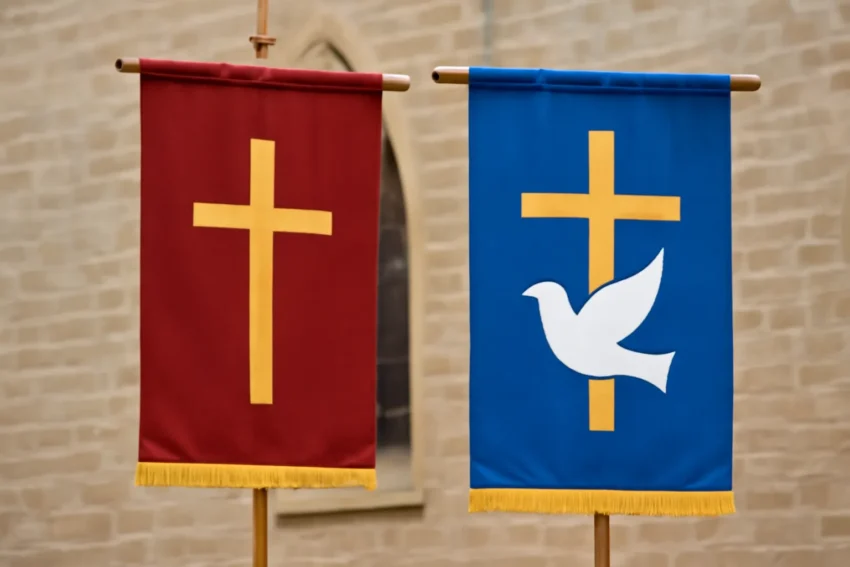
Flag-like banners add vertical emphasis and can be powerful when used in processions or to frame an altar. They often combine fabric with pole systems and tassels or fringe for ceremonial impact.
Used for processional entrances or as wall-mounted motifs.
Can be designed to correspond to heraldic crests, liturgical colors, or thematic scripture.
Lighting and backing considerations
Depending on placement, backings and lighting can change the impact of a banner. Techniques to consider:
Backlit fabric using LED light boxes or backlighting panels to create glow and depth.
Front-lit displays with spotlights for emphasis on focal pieces near the pulpit.
Double-sided banners illuminated from the back or printed on both sides for visibility from multiple directions.
Pro tip: Always test color accuracy and legibility under the lighting conditions of the space before committing to a print run.
Design principles: creating banners that communicate clearly and reverently
Good banner design blends typography, color, imagery, and symbolism with practical constraints such as readability, durability, and installation. Here are core principles to guide the process:
Clarity and readability are paramount. Favor high-contrast color combinations and large, legible type for messages intended to be read from a distance.
Color theory plays a significant role in signaling season, mood, and theological themes. For example, purple for Advent and Lent, white for Easter and Christmas, red for Pentecost and communion, green for ordinary time.
Typography should reflect the tone of the church and be legible in varying lighting. Use a few typefaces and maintain consistent hierarchy.
Imagery and symbolism should align with Scripture, iconography, and church doctrine. Symbolic elements (doves, fish, crosses, grapes, wheat) should be purposeful and not cliché.
Hierarchy of information matters. The most important message should read clearly at a distance; supporting details can be closer up.
Accessibility matters. High contrast, large fonts, and alt-text for digital versions help worshippers with visual impairment or in dim spaces.
Consistency across banners builds identity. A suite of banners designed with shared color palettes and motifs reinforces a cohesive message.
Seasonal rhythm allows banners to reflect the church calendar while preserving a unified aesthetic year-round.
Structural layouts to consider:
Vertical banners for processions or wall-mounted displays; great for tall walls and entryways.
Panoramic banners that span a wall behind the pulpit or above a stage, creating a backdrop for worship.
Panel banners modular sections that can be rearranged or expanded for different events.
Layered banners combining fabrics of different textures for depth and tactile interest.
Design workflows: from concept to installation
Effective banner design follows a structured workflow that balances ministry goals with practical production steps. A typical process looks like this:
Brief and goals: Clarify the purpose (welcome, storytelling, seasonal theme), audience, space, and budget.
Concept sketches or mood boards to explore color palettes, typography, and imagery.
Proofing with stakeholders, ensuring theological accuracy, readability, and aesthetic alignment with worship space.
Material and method selection based on location, durability needs, and budget.
Production including printing, stitching, applique, or embroidery as required.
Mounting and installation planning, including hardware compatibility, load-bearing considerations, and safety.
Maintenance plan to clean, rotate, and store banners for longevity.
Collaboration across teams—artistic leadership, facilities, administration, and pastoral staff—helps ensure that banners stay aligned with mission and are easy to maintain over time.
Digital vs. traditional: choosing the right method
Digital printing and traditional craftsmanship offer distinct advantages. Consider these factors when deciding:
Timeliness—digital printing enables quick turnarounds for seasonal messages or last-minute events.
Reusability—modular designs with interchangeable panels or clips allow reuse from one season to another.
Detail and color—high-resolution digital prints can convey fine textures and gradients; embroidery and applique provide tactile richness.
Cost—initial costs vary by method; fabric banners with embroidery may have higher upfront costs but longer lifespans, while vinyl may be cheaper and more flexible.
For churches with frequent changes or limited storage, modular systems and double-sided prints can maximize versatility and minimize waste.
Practical considerations: size, placement, and durability
Getting banners right in real spaces requires planning around the physical environment. Here are key considerations to address early in the design process:
Space and sightlines: ensure messages are readable from the back of the room or from seating areas, not just up close.
Height and width: banners should not obstruct sightlines to worship leaders or screens; consider ceiling heights and wall dimensions.
Mounting systems: determine whether banners will hang from hooks, poles, rods, grommets, or recessed tracks. Heavy banners may require steel supports or wall cleats.
Outdoor exposure (for campus signs): wind loads, sun fading, rain, and the need for UV-resistant inks and weatherproof laminates.
Maintenance and care: plan for regular cleaning, rotate banners to minimize sun exposure, and inspect seams and hardware periodically.
Safety: ensure that banners do not become trip hazards, block emergency exits, or interfere with lighting and acoustics.
Seasonal storage: develop a storage protocol for different banner families to keep fabrics clean and organized.
Customization ideas and themes: practical examples
Custom banners can reflect church identity, anniversary milestones, mission priorities, or outreach themes. Here are practical ideas organized by purpose. Bold phrases indicate ideas you can adapt across multiple banners.
Welcoming and hospitality banners
“You Are Welcome Here” banners at entrances with a warm color palette and inclusive language.
Multilingual welcome banners that greet diverse congregants, using clear typography and legible scripts.
Volunteer recruitment banners near entrances encouraging hospitality teams to connect with visitors.
Seasonal and liturgical banners
Advent banners in rich purples and golds featuring Scripture verses about anticipation and light.
Christmas banners with nativity motifs and a message of peace and joy.
Lent and Easter banners showing themes of repentance, renewal, and resurrection.
Pentecost banners highlighting the Spirit with symbols such as doves or flames and the color red.
Mission and outreach banners
Banners highlighting local service projects, food banks, and community partnerships.
Global mission banners with maps, flag motifs, or silhouettes representing partner nations.
Donor recognition banners that acknowledge gifts and long-term commitments to building campaigns.
Education and youth banners
Classroom banners that summarize key verses or thematic goals for youth ministry.
Event banners for VBS, church camps, or weekend services with bold graphics and kid-friendly typography.
Stewardship banners emphasizing responsible discipleship and generosity.
Heraldic and ceremonial banners
Banners that reflect the church’s crest, denomination, or historic symbols used in processions.
Altar banners matching liturgical colors and matching set pieces for a cohesive sanctuary look.
Memorial, honor, and donor banners
Memorial banners recognizing individuals who contributed to a project, with dates and brief scriptures.
Honor banners for anniversaries or milestones in the church community.
Trailblazer banners acknowledging families or teams who have long served the ministry.
Funding banners is a practical concern for many churches. Here are strategies to plan, price, and fund banners without sacrificing quality.
Tiered options: offer a range of materials (fabric, vinyl, mesh) at different price points, with a plan to upgrade over time.
Phased production: roll out banners in stages aligned with the church calendar or renovation timelines.
Donor recognition context: fund a banner program by naming banners after donors or groups, which can also encourage ongoing support.
Reusability: design modular banners whose panels can be swapped to reflect seasons or ministries, maximizing return on investment.
Volunteer labor opportunities: engage members who have sewing, design, or printing skills to reduce production costs.
Maintenance budgeting: allocate annual funds for cleaning, storage, and replacement parts to extend banner life.
While every church is unique, real-world situations illustrate how thoughtful banner programs can elevate ministry. Here are a couple of illustrative scenarios that exemplify design thinking and practical execution.
Case Study A: A mid-sized urban church launching a year-long outreach emphasis
A church in an urban campus used a banner suite to announce a year of community outreach. They designed a cohesive set of vertical banners for the main hallway, a pair of outdoor vinyl banners for the front lawn, and a few processional banners for Sundays. Key steps included:
Defining the message: “Reach, Serve, Grow” with seasonal variations for each quarter.
Choosing materials: durable vinyl for outdoor use and lightweight fabric banners for interior display.
Implementing a modular approach: banners consisted of interchangeable panels that could be updated quarterly without replacing entire banners.
Measuring impact: feedback from congregants and visitors suggested improved wayfinding and a stronger sense of mission alignment.
Case Study B: A rural church renovating a historic sanctuary
In a renovation project, banners helped preserve the atmosphere while introducing a modern aesthetic. Highlights included:
Creating a sanctuary banner program that echoed historic colors but used contemporary materials for longevity.
Using backlit scrim panels behind the lectern to create a focal point during services.
Documenting the process for stewardship reports and fundraising updates, with donor banners displayed prominently in the lobby.
Preserving banners increases their lifespan and ensures they continue to convey the church’s message for years. Consider these care practices:
Regular cleaning using appropriate methods for fabric, vinyl, or mesh; avoid harsh solvents that can damage graphics.
Proper storage in cool, dry environments; use padded bags or tubes to protect fabric edges and embroidery.
Inspection of seams, grommets, and mounting hardware to address wear before it becomes a problem.
Rotation of banners to minimize sun exposure on any single piece and to keep displays fresh.
Documented care guides for church staff and volunteers to ensure consistency in handling and maintenance.
Banners work best when they are part of a holistic signage ecosystem. Consider aligning banners with:
Color palettes and typography used in printed bulletins, screens, and podium materials.
Iconography and motifs that appear in stained glass, wall murals, and digital slides to reinforce a unified look.
Family of signs including door decals, wall panels, and wayfinding arrows to ensure a cohesive experience for visitors and members alike.
Event branding consistency so that campaigns look intentional and well-planned rather than ad hoc.
Inclusive signage ensures that all visitors and congregants can engage with the message. Consider:
Readable typography with high contrast between text and background.
Clear language that avoids jargon and uses inclusive terms.
Large font sizes for distance readability in large sanctuaries.
Alt-text or companion digital versions for banners that also exist online, helping visually impaired readers.
Multiple languages where appropriate to welcome multilingual communities.
Use this practical checklist to plan, design, and deploy a successful banner program that fits your church’s culture and budget:
Define purpose: Is the banner for hospitality, instruction, celebration, or fundraising?
Assess space: Measure walls, entryways, and display areas; note lighting and glare.
Choose materials: Fabric, vinyl, mesh, or a combination, considering weather, indoor conditions, and longevity needs.
Establish a color and typography system that aligns with existing branding and seasonal cues.
Create a design brief for designers or volunteers, including size specs, mounting options, and the budget.
Produce mockups and proofs for sign-offs, ensuring theological accuracy and readability.
Plan installation with safety in mind; prepare hardware and mounting locations in advance.
Develop maintenance routines and storage solutions to extend life and ease rotation.
Review and iterate after initial use; gather feedback from staff and congregants for future improvements.
Church banners are not merely decorative; they are intentional communicators of faith, welcome, and community life. When thoughtfully conceived and professionally produced, banners can:
Enhance worship spaces with color, texture, and symbolism that support the liturgy.
Improve visitor experience through clear messaging and welcoming visuals.
Support ministry goals by highlighting programs, campaigns, and partnerships.
Strengthen community memory by documenting milestones, donors, and stories of service.
Become durable assets that endure through multiple seasons and leadership transitions.
Whether you are redesigning an old sanctuary, outfitting a new campus, or refreshing seasonal décor, the principles outlined here—clear communication, durable materials, thoughtful symbolism, and inclusive design—will help you craft church banners that uplift worship, welcome strangers, and tell your church’s story with integrity and beauty.