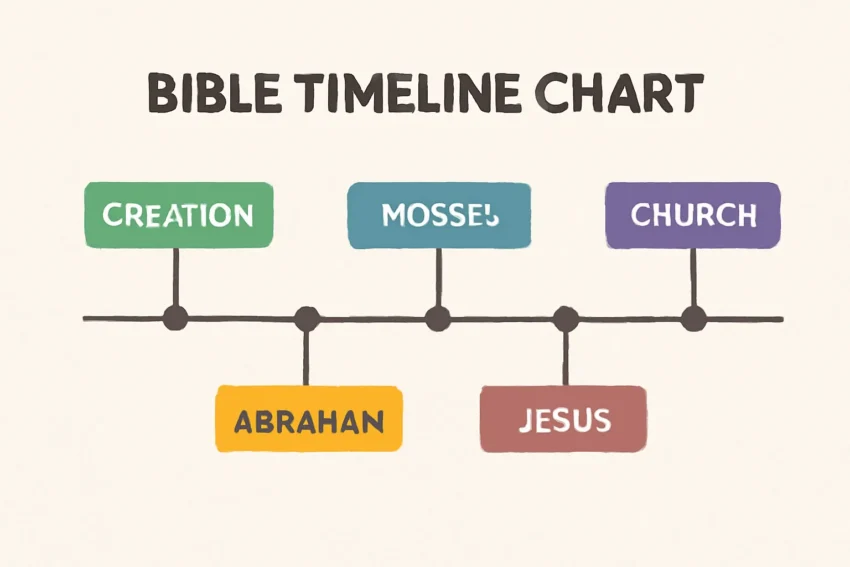
Bible Timeline Chart: A Comprehensive Visual Guide to Biblical History
The study of the Bible often begins with text and interpretation, but many readers discover that a well-constructed bible timeline chart
can transform how they understand biblical history. A timeline chart is more than a decorative graphic; it is a structured
визуал tool that helps readers place events, people, and places in chronological order, reveal connections between different
eras, and illuminate patterns that might be invisible in a prose reading alone. In this comprehensive guide, we explore what a biblical chronology chart is, how to read it, what components it typically includes, and how to design or choose a chart
that suits your study goals—whether for personal growth, classroom teaching, or scholarly research. We will discuss various
formats such as horizontal timelines, vertical timelines, circular timelines, and interactive digital timelines, and we will
provide practical tips for evaluating the accuracy and usefulness of a given chart.
What is a Bible Timeline Chart?
A bible timeline chart is a visual representation that places biblical events, eras, and characters along a
continuous axis that reflects time. Its purpose is not to replace textual study but to complement it by offering a spatial
representation of history. Readers can see how the patriarchs relate to the exile, how the monarchy interacts with the prophets,
and how the life of Jesus sits within the broader story of salvation history. Variants of this concept include the timeline of Bible events, the biblical chronology chart, and the broader concept of a scriptural timeline.
Some practitioners distinguish between a bible timeline chart and a thematic timeline. A
thematic timeline emphasizes topics such as covenants, journeys, or genealogies, while a traditional chronology focus on
sequential events. Regardless of the emphasis, a well-constructed chart provides:
Spatial clarity about when events occurred relative to each other.
Contextual parallels that reveal cultural, political, or theological influences.
Reference points for dates, periods, and durations that can anchor more detailed study.
Key Components of a Bible Timeline Chart
A robust bible timeline chart typically includes several core components. While not every chart will
include all elements, understanding these parts helps readers evaluate and use timelines more effectively.
Time axis: The horizontal or vertical line that represents chronological progression. Depending on the design, the axis may be labeled in
years BCE/CE, decades, centuries, or key biblical periods (e.g., Patriarchal Era, United Monarchy, Exile).
Era blocks: Segments that group events into overarching periods, such as Creation/Patriarchs, Exodus and Wilderness, Conquest and Judges,
United Monarchy, Divided Kingdom, Exile, Return and Intertestamental period, and Life of Jesus and the early church.
Event markers: Specific events or milestones with dates (or approximate dates) and brief descriptions. Some charts
also include sources or cross-references to Scripture passages.
Genealogical ladders (where applicable): Lines that indicate family connections between generations, such as the genealogies
from Genesis or Luke’s gospel. These ladders help readers understand lineage and chronological anchor points.
Cross-references: Notes that connect events to related passages, cultural contexts, or archaeological findings that illuminate the text.
Color-coding: Visual cues that differentiate eras, themes, or types of events (e.g., covenants, wars, exiles, or miraculous acts).
Legend: A key that explains symbols, colors, and abbreviations used in the chart so readers can interpret the design consistently.
Dates and approximate dating: Some charts indicate exact dates when known, while others use approximate ranges (e.g., c. 1440–1400 BCE)
based on scholarly consensus.
Why Use a Timeline for Biblical Studies?
The biblical story is inherently episodic, but it is also a unified narrative that stretches across many centuries and cultures.
A bible timeline chart helps learners and researchers:
See the broad arc of biblical history and identify how early chapters relate to later developments.
Compare parallel streams, such as the Israelite monarchy and the surrounding nations, to gain a fuller historical context.
Identify pivotal turning points, including covenants, exiles, and reforms, that influence the theological trajectory of the text.
Expose complexities and debates around dating, such as how long certain monarchies lasted or when major events occurred.
Facilitate classroom activities, independent study, and discussion by providing a common visual framework.
Design Considerations for a Bible Timeline Chart
When designing a bible timeline chart, several design considerations help ensure the chart is readable, accurate,
and useful. The following factors should guide the production and evaluation of a chart, whether you are building one from scratch
or selecting a ready-made version.
Scope and focus: Decide whether your timeline covers creation to the modern church, or focuses on a particular
portion of biblical history (e.g., the Pentateuch era, the prophetic period, or the life of Jesus).
Time scale: Choose an appropriate time scale. Fine-grained scales (decades) can be excellent for the monarchy and post-exilic periods,
while broader scales (centuries) may be more suitable for creation-to-exodus or the biblical canon as a whole.
Granularity: Determine how many events to include. A dense chart with many markers is informative but can become cluttered;
a sparser chart may highlight only major milestones.
Accuracy and source fidelity: Prefer charts that cite sources for dates and interpretations, and acknowledge areas
of scholarly disagreement. When dates are estimates, indicate them clearly (e.g., ~, ca., or BCE/CE).
Clarity and legibility: Use legible fonts, contrasting colors, and consistent labeling. Avoid overcrowding and provide clean legends.
Cultural and theological nuance: Recognize that the chronology is not merely a set of numbers; it reflects the biblical authors’ theological priorities
and the historical memory of communities.
Variations of Bible Timeline Charts
There are many ways to present a bible timeline chart, each with strengths for different audiences and purposes. Below are several common
formats, along with notes about their advantages.
Horizontal timelines: The classic format, with a left-to-right axis. Horizontal layouts excel for showing relationships across time and are easy to annotate with event labels.
Vertical timelines: Useful when space is constrained in a page or screen, or when you want to emphasize a vertical ascent or descent (e.g., from creation to redemption).
Circular timelines (or radial timelines): Particularly effective for showing cyclical themes or the broader arc of salvation history that returns to renewal and restoration.
Layered timelines: Combine multiple strands (e.g., political history, religious history, and literary periods) in parallel tracks to reveal correlations.
Thematic timelines: Focus on specific topics (covenants, kings, prophets, exile) rather than solely on chronological sequencing.
Interactive timelines: Digital charts that allow users to click on events for notes, maps, or primary sources, enabling deeper exploration.
Common Eras and Major Blocks in a Bible Timeline Chart
Although there is diversity in how timelines are constructed, most comprehensive charts segment biblical history into well-recognized
eras. Each era has distinctive themes, leaders, and rites that are essential for understanding the biblical narrative as a whole.
Creation and Patriarchs — Covers creation, the patriarchs (Abraham, Isaac, Jacob), and early familial covenants; sets the theological frame for the story.
Exodus and Wilderness — The liberation from Egypt, the giving of the Law at Sinai, and the wilderness years; highlights covenant identity and divine provision.
Conquest and Judges — Israel’s settlement in the land, tribal confederacy, and cycles of faithfulness and apostasy under the judges.
United Monarchy — The reigns of Saul, David, and Solomon; a period of political consolidation, temple building, and expanded influence.
Divided Kingdom — The split into Israel and Judah, prophetic activity, and the increasing tension with neighboring powers.
Exile and Return — The destruction of Jerusalem, exile to Babylon, and eventual return under Persian patronage, including reforms and rebuildings.
Intertestamental Period — The cultural and religious developments between the Testaments, including cultural shifts and the background to the New Testament world.
Life of Jesus and Early Church — The birth, ministry, death, and resurrection of Jesus, followed by the growth of the early church and missionary expansion.
Important Cross-Cutting Topics
Beyond the broad era blocks, many bible timeline charts incorporate cross-cutting topics that intersect multiple periods. These include:
Covenants (Abrahamic, Mosaic, Davidic, and the New Covenant) and how they shape expectations across eras.
Judges and Prophets as a continuous emphasis on faithfulness, warning, and hope in exile contexts.
Temple and Worship practices, including tabernacle, temple rituals, and the shift in worship paradigms after the exile.
Archaeology and Context— Integration of archaeological findings and ancient Near Eastern history that illuminate biblical texts.
Kingdoms and Empires— How regional powers (Egypt, Assyria, Babylon, Persia, Greece, Rome) influence biblical events and theology.
Reading and Interpreting a Bible Timeline Chart
A timeline is a tool for interpretation as much as a reference. When reading a bible timeline chart, consider the following practices to extract maximum value:
Identify anchor points: Locate well-established events with consensus in biblical studies (e.g., Exodus, reigns of David and Solomon, Babylonian exile, life of Jesus) and use them as anchors for dating nearby events.
Note uncertainties: Recognize dating debates and periods of approximate dating. A good chart will often indicate ranges (e.g., c. 1445–1405 BCE).
Consider literary context: Understand that biblical authors often present history with theological aims. A chart should reflect this by providing thematic labels alongside chronology.
Map to geography: When possible, pair the timeline with maps showing ancient routes, cities, and regions to ground events in space as well as time.
Use multiple layers: If available, consult layered timelines that show political history, religious history, and literary genres in parallel to gain a fuller picture.
Constructing a Bible Timeline: A Step-by-Step Guide
Whether you are a student building a bible timeline chart for a class, a teacher preparing materials for the
next unit, or a curious reader assembling your own personal reference, here is a practical workflow.
Define the scope: Decide whether your chart covers the entire Bible or a specific portion. Clarify the starting point and ending point.
Choose a format: Select a format (horizontal, vertical, circular, or interactive) based on your audience and platform.
Collect data: Gather dates, event names, and brief descriptions from reliable sources. Note where dates are uncertain.
Organize into eras: Group events into recognizable periods (patriarchs, exodus, monarchy, exile, life of Jesus, early church).
Design annotations: Create clear labels, symbols, and color codes for easy scanning. Include a legend.
Incorporate cross-references: Link events to Scripture passages or external sources for deeper study.
Review for accuracy: Cross-check with scholarly references and adjust as necessary. Consider alternative chronologies when appropriate.
Test readability: Share drafts with peers or students to ensure the chart communicates effectively and is not overly complex.
Tools and Resources for Bible Timeline Charts
There is a broad ecosystem of tools and resources that can help you create, view, or study a bible timeline chart.
These range from simple printed posters to sophisticated digital platforms. Here are categories and examples you may encounter.
Printed timelines: Laminated scrolls, posters, and wall charts that are durable for classroom use and personal study spaces.
Digital charts: Web-based timelines or apps that render timelines interactively on computers or tablets.
Template libraries: Collections of editable templates that allow you to customize eras, events, and labels for your own study.
Scholarly references: Biblical archaeology reports, chronological debates, and canonical dating work that inform the dates and ordering.
Map integration: Maps layered with timelines to connect places with events, enabling geographic-historical analysis.
Historical Challenges in Dating Biblical Events
Dating biblical events is a nuanced task. Scholars employ various methodologies, including textual analysis, cross-cultural comparisons,
and archaeology, to assemble plausible chronologies. Time reckoning in the ancient world differed from modern calendars, and some periods
feature overlapping reigns, co-regencies, or symbolic dating rather than precise years. When building or using a bible timeline chart,
it is important to acknowledge:
Regnal dating (reigns of kings) vs. event dating: Kings’ reigns are often used as anchors, but the exact year of certain events may be unclear.
Co-regencies: Some rulers started their rule jointly with predecessors, complicating a simple sequential timeline.
Approximate dating: Many dates are estimates based on external sources, such as Egyptian chronology or Babylonian astronomy.
Synchronisms: Cross-references to other cultures or calendars may provide alternative anchors for aligning events.
Examples of Notable Bible Timeline Charts in Practice
Across educational and scholarly contexts, various bible timeline chart designs have gained popularity. Some are simple
and elegant for classroom use, while others are expansive reference tools that accompany study Bibles or encyclopedic volumes.
Basic classroom timeline: A compact, color-coded horizontal chart focusing on major milestones such as Creation, Exodus, United Monarchy, Exile, and Life of Jesus.
Comprehensive canonical timeline: A longer vertical or horizontal layout that spans Genesis to Acts, with detailed event markers and cross-references.
Thematic chronology: A chart organized by themes (covenants, covenants fulfilled, prophetic might) rather than strictly by date.
Interactive digital chronology: A dynamic timeline with tooltips, pop-ups, and maps to enhance engagement and allow deep dives into sources.
Practical Exercises: Using a Bible Timeline Chart in Study
If you are a student, teacher, or lifelong learner, these practical exercises can help you get the most from a bible timeline chart.
Exercise A: Anchor and fill — Start with the anchor events you know well (e.g., the Exodus, the reign of David, the Babylonian exile, the life of Jesus). Then add related events to create a coherent narrative.
Exercise B: Compare timelines — Compare two timelines that place the same events but use different date ranges or sources. Note where they agree and where they diverge, and explore reasons for the differences.
Exercise C: Thematic mapping — Create a second timeline that highlights a theme (e.g., covenants or temple worship) and see how that theme unfolds across eras.
Exercise D: Geography and chronology — Pair a timeline with a map to connect dates to places. Mark journeys, migrations, and campaigns to deepen spatial understanding.
Case Studies: How Different Communities Use Bible Timelines
Different communities implement and adapt bible timeline charts in ways that reflect their educational goals, theological emphases,
and historical contexts. Here are a few illustrative cases:
Church education — In Sunday schools and adult education programs, timeline charts help learners grasp the overall narrative arc and see the continuity
from creation to redemption. Simple color-coding and clear labels make the chart accessible to a broad audience.
Seminary study — In academic settings, more nuanced timelines include scholarly debates about date ranges, cross-referenced sources, and archaeological notes.
Kids’ study Bibles — Timelines designed for children emphasize visual clarity, with bold icons representing major events for quick recognition and memory.
Scholarly reference works — Detailed chronologies in reference works emphasize precision, critical discussion of dating, and alignment with external ancient calendars.
Common Pitfalls and How to Avoid Them
While a well-crafted bible timeline chart can be immensely helpful, certain common pitfalls can undermine its usefulness. Here are some
cautions and solutions:
Overloading with minor events: Too many markers can obscure the main trajectory. Solution: focus on major milestones and use a secondary layer for less essential details.
Ambiguous dating: If dates are uncertain, clearly label them as approximate and provide a note about the source or method used.
Ignoring literary structure: Chronology should be integrated with literary form. Solution: annotate shifts in genre, authorship, and perspective.
Confusing BCE/CE conventions: Make sure the calendar system is explained in the legend, especially for readers new to ancient dating conventions.
Disconnection from geography: Combine time with space to avoid a purely abstract chronology. Include maps or geographies alongside the timeline when possible.
Accessibility and Educational Considerations
A well-made bible timeline chart should be accessible to diverse audiences, including students with different learning styles,
readers with visual impairments, and non-native English speakers. Consider these accessibility principles:
Text alternatives: Provide alt text for any images in digital charts and captions for printed charts.
High-contrast design: Use strong color contrast and large font sizes for readability.
Clear labeling: Use unambiguous event names and brief descriptions that do not assume specialized knowledge.
Keyboard navigability: In digital formats, ensure timeline content is accessible via keyboard navigation and screen readers.
Integrating Bible Timelines with Other Study Tools
To maximize learning, integrate a bible timeline chart with other study resources. Some effective integrations include:
Scripture cross-references: Link to passages or pericopes that illuminate specific events.
Archaeological materials: Include notes or links to archaeological findings that provide cultural context for the era.
Maps and geography: Add maps showing routes, cities, and empires mentioned in the timeline.
Glossaries: Provide a glossary of terms such as «co-regency,» «exile,» and «covenant» to support readers new to biblical studies.
Beyond the Page: Digital and Interactive Timelines
The digital era offers exciting possibilities for bible timeline charts. Interactive timelines can transform a static page into a living
resource that invites exploration. Features to consider:
Tooltip details— Hovering over an event reveals dates, source citations, and related passages.
Expandable layers— Users can add or remove layers (e.g., political history, religious history, liturgical calendar) to customize the view.
Search and filter— Ability to search for events by keywords or filter by era, theme, or region.
Synchronic maps— Simultaneous display of maps and timelines to show how geographic context interacts with chronology.
Sample Outline for a Comprehensive Bible Timeline Project
If you are planning to create a thorough bible timeline chart, consider the following outline as a starting point:
Introductory overview — A succinct explanation of purpose, scope, and intended audience.
Legend and design — Color-coding, symbols, date formats, and legends to enable easy interpretation.
Era blocks with anchors — Major eras with anchor events that serve as reference points for dating nearby events.
Event library — A curated list of events with dates, descriptions, and Scriptural references.
Cross-references and notes — Links to passages, scholarly opinions, and archaeological context.
Maps and geography — Supplemental maps showing travel routes, empires, and key sites.
Student-friendly activities — Guided exercises, discussion prompts, and assessment ideas.
Conclusion: The Value of a Bible Timeline Chart
A bible timeline chart is a powerful pedagogical and devotional tool. When constructed with care, it provides a clear,
visually engaging representation of biblical history that complements textual study and helps readers see the coherence of the biblical
narrative across centuries. The best timelines are precise in their dating where possible, honest about uncertainties, and rich in context
that invites further exploration—geography, archaeology, theology, and literary form. By embracing a variety of formats—horizontal or vertical,
circular or layered, printed or digital—a timeline of Bible events can meet diverse learning needs and adapt to different
educational settings. Whether you are building your own biblical chronology chart for a classroom, a church library, or a personal study,
the essential goal remains the same: to illuminate the arc of the biblical story and to empower readers to engage with Scripture more deeply.
In the end, the value of a well-made bible timeline chart lies not only in the dates it lists but in the
questions it invites: How did the covenants shape the people’s expectations? How did the surrounding empires influence the biblical
narrative? What role did geography play in the movement of people and ideas? A thoughtful timeline invites readers to walk through time
with purpose, curiosity, and a renewed sense of connection to the sacred text.
Whether you call it a bible timeline chart, a timeline of Bible events, or a biblical chronology chart,
the essential work is the same: to render the vast narrative of Scripture into a navigable, meaningful, and teachable format. By doing so,
we equip learners to see not only what happened, but why it matters—how a sequence of events in the ancient world speaks to faith, hope,
and transformation today. May your exploration of biblical history be clarified, enriched, and enlarged by the thoughtful use of timelines.