Contemporary Christian Artwork stands at the intersection of faith and visual culture in the 21st century. It is not a single style or a single medium, but a broad, evolving field that embraces painting, sculpture, installation, digital media, performance, and public art. What unites these works is a shared interest in theology in visual form, a pursuit to translate doctrine, scripture, and lived faith into images that can be seen, felt, and engaged with in everyday life. This article surveys the landscape of modern faith in visual form, examining how artists interpret Christian narratives for new audiences, challenge inherited iconographies, and participate in conversations about justice, hope, and community in a rapidly changing world.
What counts as contemporary Christian artwork is both expansive and particular. It encompasses pieces made within church spaces, in secular galleries, in public installations, and in digital environments. It includes works created for worship and for contemplation, as well as pieces intended for critique and dialogue. The field often blends old and new: the resonance of traditional iconography can be reimagined through contemporary abstraction, multimedia collage, or immersive installation. The vocabulary can be biblical, liturgy-informed, or worldly—yet all tend to share a concern with how faith inhabits a modern life that is plural, complex, and technologically mediated.
In a practical sense, contemporary Christian artwork involves three key elements:
Content rooted in Christian scripture, theology, or lived faith—from parables to parousia (the coming kingdom), from mercy to sacrifice.
Form that uses the possibilities of today’s media, including painting in new palettes, sculpture that invites touch or passage, and digital or sound-based works that unfold over time.
Context—the setting where the art is encountered, whether it is a church nave, a gallery, a public plaza, or an online platform—where community interpretation and reception become part of the artwork’s meaning.
Historical Context and Continuities
Contemporary Christian artwork does not emerge from a void. It sits within a long lineage of visual faith—from early cryptic symbols in catacombs to medieval altarpieces, from Reformation-era printmaking to modern religious art movements. However, the last few decades have seen a shift in scale, access, and intention.
From Icon to Image: A Line of Dialogue
Across centuries, Christian imagery has governed how believers imagine sacred realities. In the medieval period, iconography conveyed doctrine through carefully codified forms. In the modern era, artists began to challenge, reinterpret, or subvert those codified forms to speak to new audiences and concerns. Today’s contemporary religious art often treats iconography not as a fixed code but as a living language—one that can bend toward experimentation while still bearing witness to faith.
This long arc helps explain why today’s works frequently straddle vocation and critique: some pieces reaffirm tradition through reverent technique, while others push against boundaries to examine how faith intersects with science, migration, political conflict, or climate justice. The field thus demonstrates a dynamic continuity: a concern with meaning, beauty, and truth expressed through modern media and in dialogue with a diverse audience.
Core Themes in Contemporary Christian Artwork
Incarnation, Redemption, and Presence
A central thread in many contemporary religious artworks is the theology of presence. Rather than imagining God as distant or abstract, many works foreground the belief that the divine is accessible—through the cruciform story, through neighbor, through creation. Artists explore how incarnation—the idea that divine life becomes flesh— manifests in everyday environments: a street corner, a hospital ward, or a classroom. Visual representations may emphasize light and movement to signify grace breaking into ordinary time, or they may embed narrative sequences that invite viewers to walk with characters through suffering toward restoration.
Hope, Justice, and Healing
Faith communities these days frequently align with social justice conversations. Contemporary Christian artwork often treats hopeful vision as a public act—an invitation to imagine better futures and to lament present harms. Works may address racial reconciliation, migration and asylum, refugee families, poverty, or environmental stewardship. The art becomes a form of moral imagination, offering not simply consolation but also a springboard for concrete action.
Identity, Diversity, and Belonging
The global church is not monolithic. Contemporary Christian artwork frequently foregrounds identity and intersectionality, exploring how race, gender, sexuality, culture, and class shape faith expressions. Some works center voices that have historically been marginalized within traditional ecclesial art—indigenous expressions, women’s perspectives, or artists from postcolonial contexts—thereby broadening the visual vocabulary of Christian faith and inviting broader participation in worship and story.
A growing thread in contemporary religious imagery is the relationship between faith and the natural world. Works in this vein may depict creation as a living system, critique ecological degradation, or imagine communities practicing sustainable care for land and water. The visual language often blends scientific imagery with sacramental symbolism to encourage ethical responsibility and wonder.
Community, Worship, and Public Space
Site matters. Some artists design installations that transform church architecture, while others create public commissions that invite non-churchgoers into a contemplative encounter with faith. The boundary between worship aesthetics and public art becomes porous, enabling conversation across varied communities. In some contexts, the artwork itself becomes a site for communal ritual, prayer, or response.
Mediums and Techniques
Painting and Mixed Media
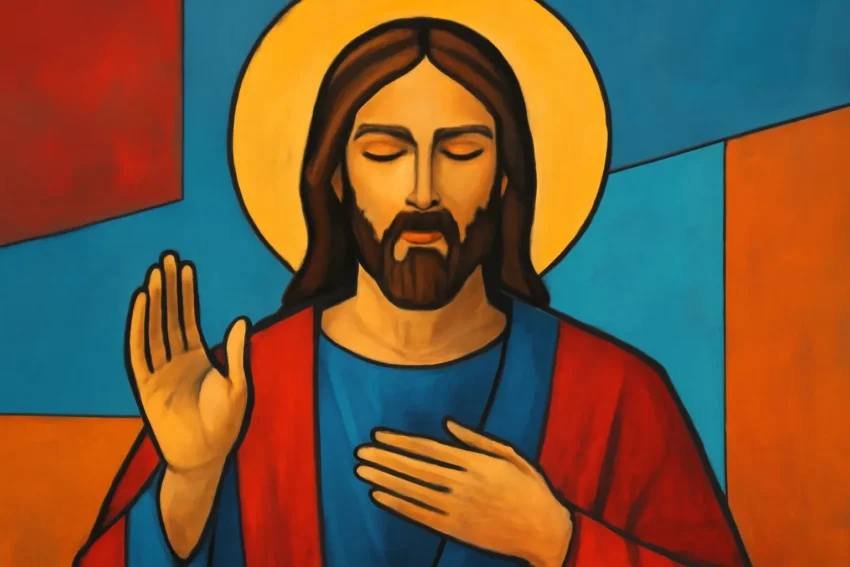
In contemporary Christian painting, artists experiment with color, texture, and surface to convey spiritual narratives. You will find abstracted icons, gestural representational forms, and layered surfaces that evoke memory and mystery. Mixed media approaches—combining pigment, paper, fabric, metal leaf, and found objects—create tactile inquiries into faith as a lived experience. The painterly gesture can be a form of prayer, the act of laying down color a meditative discipline.
Sculpture and Installation
Sculpture and installation offer scale and physical immersion that painting sometimes cannot. Contemporary Christian sculptors may build environments that envelop the viewer, using space as a theological argument: light pours through openings to signify grace; materials are arranged to invite path and touch; or immersive installations encourage spectators to move through a narrative as if they were participants in a parable.
Digital Art, New Media, and Virtual Realities
Digital media has opened wide horizons for contemporary Christian artwork. Generative art, video installations, digital painting, and interactive experiences enable artists to animate scripture and gospel narratives in dynamic ways. Some works incorporate augmented or virtual reality to let viewers encounter scenes of biblical history in situ, while others deploy social media as a platform for communal storytelling, liturgy, or devotional practice.
Sound, Performance, and Time-Based Art
Sound art and performance bring temporal dimension to faith-informed art. Composers and performance artists create works in which breath, chant, instrument, or environmental sound become theological argument. Time-based pieces—where silence or rhythmic loops punctuate the viewer’s encounter—mirror the rhythms of prayer and scripture reading, turning attention toward interior transformation as much as outward perception.
Public Art and Architecture
The public realm offers a compelling stage for Christian visual language. Murals, sculpture gardens, and architectural commissions can recast urban spaces into places of encounter and reflection. Faith-informed public art can engage passersby who might not attend church, inviting contemplation of moral questions and shared humanity in civic life.
Symbolism and Theology in Visual Language
Christian imagery has a rich symbolic tradition. Contemporary works often remix or reframe traditional symbols to speak to today’s viewers. The following are common visual motifs and the theological energies they carry:
Cross: not only a symbol of sacrifice but also a sign of invitation, atonement, and public witness.
Dove: peace, the Spirit, and renewal; sometimes decentered to emphasize movement and breath.
Fish (ichthys): historical gospel shorthand reimagined in modern contexts, sometimes embedded in abstract forms or graffiti-like compositions.
Light and dark: illumination, revelation, and divine presence, or the journey from ignorance toward grace.
Water: baptism, cleansing, life, and the renewing power of God’s Spirit.
Bread and wine: Eucharistic memory, community, and sustenance in faith.
Nails and crown of thorns: sacrifice, suffering, and the paradox of glory revealed through vulnerability.
Olive branches and vine imagery: reconciliation, peace, and growth in faith communities.
Color symbolism: gold for divinity and majesty; white for purity and resurrection; red for sacrifice; blue for heaven and mercy; green for life and renewal.
Theological reading of visual work in contemporary settings often involves a collaborative dynamic: artists, theologians, curators, and congregants bring their interpretive frames. The aim is not only to illustrate doctrine but to create visual theologies—ideas about God and life that viewers can inhabit as they engage with the artwork.
Global Perspectives
Christian art today is transnational. Different regions cultivate distinctive aesthetics, narratives, and concerns, while sharing a common impulse to translate faith into visible form. The following snapshots offer a sense of how contemporary Christian artwork manifests around the world.
North America and Europe
In North America and Europe, contemporary Christian artwork often engages with institutional church life, urban church communities, and post-secular dialogues. Museums and galleries host exhibitions that pair biblical themes with modern existential questions—identity, justice, and meaning in a media-saturated era. Many artists in these regions work in collaboration with churches, universities, and interfaith or ecumenical networks, imagining worship-informed practices that respond to social fragmentation, political polarization, and the climate crisis.
In Latin American contexts, faith often travels with strong communal and artistic traditions—mural painting, religious processions, and devotional imagery linked to Catholic and Pentecostal communities. Contemporary artists here frequently fuse iconography with urban life, social memory, and liberation theologies. Public art projects may become sites of memory for marginalized communities, preserving testimonies of resilience and faith in the face of displacement or violence.
Africa and the Middle East
Across Africa and the broader Middle East, Christian artists work within diverse cultural matrices—from Ethiopian iconography to postcolonial urban art and diaspora communities. Works frequently emphasize hospitality, kinship, and communal memory, while attending to historical traumas and current realities. Carving, textile arts, and sculpture often incorporate traditional crafts, creating bridges between ancient practices and contemporary questions about justice and identity.
Asia and Oceania
In Asia and Oceania, Christian visual language merges indigenous aesthetics, local theological concerns, and global Christian discourses. Artists may explore incarnation through nature motifs, connect scriptural narratives with local myths, or respond to migration, religious pluralism, and national identity. The result is a rich tapestry of forms—from calligraphic painting to installation that uses available urban materials—reflecting a faith life embedded in place.
Artists, Movements, and Case Studies
This section highlights a few representative approaches to contemporary Christian artwork and offers a sense of how artists engage the field in practice.
Makoto Fujimura and Culture Care
One of the most influential voices in contemporary Christian painting is Makoto Fujimura, whose Culture Care philosophy reframes art as a cultural practice that cultivates beauty, carries a gospel message, and fosters cross-cultural dialogue. Using nihonga techniques—watered-down pigments and mineral pigments on traditional Japanese paper—with gold leaf and abstract forms, Fujimura creates works that radiate spiritual luminosity. His approach treats art-making as stewardship, urging artists to care for culture itself by engaging with science, business, education, and media. In his practice, faith becomes a practice of hospitality toward culture, inviting viewers to reflect on how beauty can heal division and nourish hope.
A second illustrative mode appears in community-driven installations staged within urban churches or secular galleries. These pieces may involve congregational participation, collaborative print projects, or open studio residencies that invite a broad public to contribute to a shared narrative. Such works highlight the democratic potential of religious imagery: the artwork becomes not property owned by a single artist, but a living document of a community’s faith and concerns.
Public Faith in Installations
Public art projects anchored in Christian themes often address social realities head-on. A case study might involve a series of public sculptures placed in a city square commemorating migrant families, a traveling installation that pairs biblical parables with storefronts in diverse neighborhoods, or a multi-sensory piece that invites visitors to pause, listen, and reflect on mercy and justice. These projects demonstrate how contemporary Christian artwork can engage people beyond traditional church spaces, turning streets into contemplative corridors and inviting spontaneous acts of remembrance and solidarity.
Text and Image: Graphic Narratives
Graphic narratives—comic panels, illustrated Bibles, or sequential art—offer accessible ways to convey biblical stories and theological ideas. Some artists integrate scriptural texts with bold imagery, employing contemporary typography, color palettes, and page layouts that make timeless stories feel immediate. This approach often resonates especially well with younger audiences or communities that value visual storytelling as a primary mode of learning and prayer.
Challenges, Critiques, and Responsible Practice
The field of contemporary Christian artwork faces a number of important questions and tensions. Engaging with these challenges thoughtfully helps ensure that the art remains meaningful, responsible, and faithful to its aims.
The balance between reverence and critique: How can artists honor sacred narratives while inviting honest questions about harm, injustice, or doctrinal disputes?
Representation and inclusion: Are marginalized voices represented? Do the works reflect diverse communities within the global church?
Interpretation and authority: Who interprets a given piece—the artist, the theologian, the audience, or the curator? How do communities hold space for varied readings?
Commercialization and patronage: In markets where Christian art can become a commodity, how can artists preserve integrity and avoid sensationalism?
Authenticity and identity: How can artists articulate beliefs without imposing a single doctrinal line, allowing a plurality of expressions while maintaining a clear sense of purpose?
These questions are not obstacles but invitations to deeper practice. Responsible contemporary Christian artwork often embraces dialogue, invitation, and accountability, aiming to be transformative for both artists and viewers.
Education, Pedagogy, and Faith-Based Practice
For educators, pastors, and curators seeking to cultivate an ecosystem where contemporary faith-inflected art can flourish, several strategies prove effective.
Curricular integration—link art projects to scripture study, liturgy, and social ethics; use image-rich resources to accompany theological reflection.
Residency and collaboration—support artist residencies in churches, universities, and museums to promote cross-pollination between disciplines and communities.
Public programs—organize artist talks, studio visits, and gallery tours that foreground both aesthetics and theology, enabling lay audiences to engage with complex ideas in accessible ways.
Ethical engagement—teach about representation, cultural sensitivity, and the responsibilities of image making in a plural society.
Accessible presentation—offer captions, translations, audio guides, and tactile elements where possible so that diverse audiences can experience the work.
In practice, educators often design faith-informed art curricula that encourage students to experiment with their own visual language while reflecting on scripture and tradition. The goal is not to prescribe belief but to equip learners to see, interpret, and create with integrity, courage, and imagination.
Exhibition Spaces, Curatorial Practice, and Audience Engagement
The way contemporary Christian artwork is displayed can significantly shape how audiences receive it. Curatorial strategies influence interpretation, affect emotional reception, and determine which conversations are foregrounded.
Contextual curation—placing religious artwork in dialogue with secular art to illuminate shared concerns, such as justice, care for creation, and human dignity.
Immersive environments—designing spaces where light, sound, scent, and texture converge to invite contemplation and prayerful attention.
Dialogical display—facilitating conversations between artists, theologians, and parishioners to explore the artwork’s meanings and implications.
Accessibility and inclusion—ensuring programs are welcoming to people with diverse backgrounds, languages, abilities, and faith commitments.
Documentation and scholarship—maintaining catalogues, essays, and interpretive materials that articulate theological and artistic intentions for posterity and study.
In church settings, artwork often serves as an anchor for worship and catechesis. In museums and galleries, it participates in the broader conversation about how faith shapes culture. In both cases, the most enduring works tend to be those that invite ongoing conversation rather than delivering a single, unambiguous message.
Practical Guide for Readers: How to Engage Contemporary Christian Artwork
Whether you are a student, a pilgrim, a curator, or a curious passerby, here are practical ways to engage with contemporary Christian artwork meaningfully.
Take time to observe. Note what first captures your attention: color, form, texture, or space. Consider how these elements relate to a biblical theme or spiritual concept.
Read context. If an artist provides a statement, use it as a starting point but let your interpretation unfold in dialogue with the imagery.
Consider the space. How does the environment of the artwork—its lighting, scale, and acoustics—shape your experience of faith and doubt?
Dialogue across perspectives. If you are comfortable, discuss the work with others who have different beliefs or experiences. The diversity of readings can enrich your own.
Reflect on embodiment. Ask how the artwork invites you to consider your own body, time, and community as part of the Christian story.
Conclusion: The Promise and Potential of Modern Faith in Visual Form
Contemporary Christian artwork represents a vibrant, searching, and generous facet of modern religious life. It is a field that honors tradition while leaning into the future, respecting reverence while encouraging questions, and valuing expertise while inviting lay participation. The result is modern faith in visual form that is not merely decorative but transformative: a visual gospel that can accompany, critique, and enlarge our sense of what it means to live as people of faith in a complicated world.
As the field continues to grow, its best works will likely demonstrate several interconnected virtues: clarity and openness of message, technical excellence across media, ethical consideration of representation and impact, and a willingness to cross boundaries—between church and gallery, between tradition and innovation, between local communities and global conversations. Whether you encounter them in stained-light sanctuaries, urban galleries, or digital spaces, contemporary Christian artworks invite you to see differently, to listen more deeply, and to participate in a shared, living narrative—one that situates faith within the beauty, vulnerability, and longing of contemporary life.
Figure: An example of contemporary Christian painting that emphasizes light and presence.
In pursuing this art form, artists, curators, and communities demonstrate that faith can be a creative discipline—a way to imagine hope, cultivate mercy, and bear witness to grace in a world that desperately seeks meaning. The conversation around contemporary Christian artwork is ongoing, dynamic, and inclusive of voices across cultures and generations. As audiences continue to engage with these works, the visual language of faith will continue to evolve, inviting each viewer to participate in a shared experiment of perception, memory, and hope.