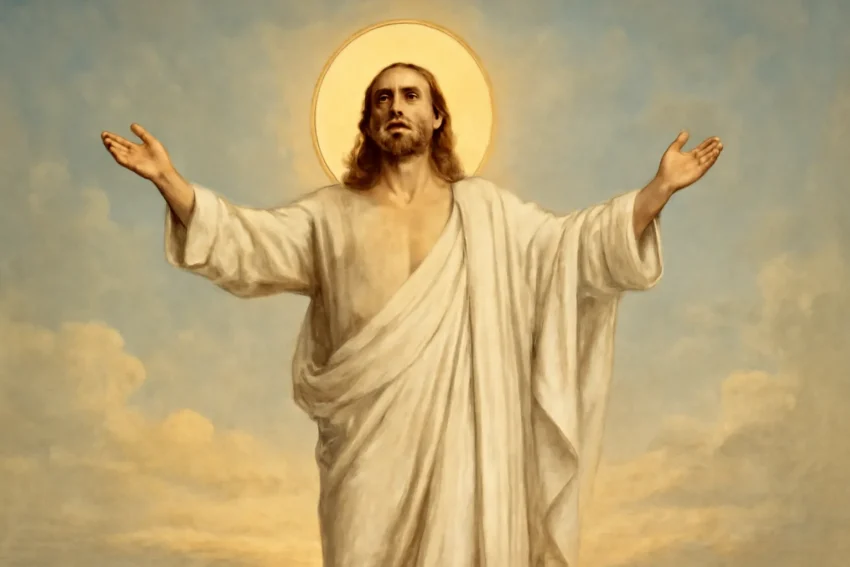
Introduction: Why talk about Christ Rose and the Resurrection?
The phrase Christ rose signals more than a historical claim; it anchors a narrative that has shaped
calendars, cultures, and personal lives for two millennia. In Christian discourse, the idea that the Risen Christ conquers death is both a doctrinal statement and a lived invitation. When we say Jesus rose, we point to a transformative event—the centerpiece of the Christian story—that reorients
time, purpose, and hope. Across traditions, the language may vary—some speak of the Resurrection of
Christ, others of the empty tomb, still others of the appearance stories where the risen Lord
meets his followers. Yet all of these lines of thought converge on a single claim: new life is possible
because life itself has been defeated by love and power greater than death.
This article explores what the Resurrection is, why it matters, and how Christians orient their faith and practice around this conviction. We will address
definitions, historical context, theological significance, and practical implications for belief, ethics, worship,
and everyday living. The intent is not to settle every debate about interpretation, but to offer a clear,
expansive account of the central claim that the Risen Christ has made possible a reordered
world—one in which mercy, justice, and hope are not wishes but realities that shape how people live.
What is the Resurrection?
The term Resurrection refers to the rising of Jesus from the dead after his crucifixion. In Christian faith,
this event is not simply a matter of a body returning to life; it is understood as a decisive act of God that
inaugurates a new creation and confirms Jesus’ identity as the Messiah, the Son of God, and the Lord of all.
Defining features of the Resurrection narrative
Empty tomb as an initial sign: Early witnesses report that Jesus’ tomb was found empty.
Appearances of the risen Jesus: Various encounters—sometimes to individuals, sometimes to groups—reveal that Jesus lives in a new, risen form.
Continued presence and commission: The risen Christ commissions his followers to continue his mission in the world.
Transcendent victory over sin and death: The Resurrection is interpreted as the defeat of the powers that threaten life, justice, and dignity.
Throughout Christian history, believers have described the Resurrection of Christ using a variety
of images—new creation, firstfruits, reversal of shame, and dramatic vindication. Each of these images emphasizes a
different facet of what the event signifies: God’s faithfulness, the promise of transformation, the integrity of Jesus’
mission, and the certainty that history is not merely a random sequence of days but a narrative that culminates in life.
Different ways to phrase the same event
To speak of the event in a richer way, many Christians employ multiple expressions. Some common variations include:
Christ rose from the dead or Jesus rose
The Resurrection of Christ as a theological category
The Risen Jesus who meets his followers after the crucifixion
The proclamation that the risen Lord is alive and reigning
A liturgical phrase such as Christ is risen or Alleluia—he is risen
Each of these formulations highlights a different dimension—historical, experiential, doctrinal, or liturgical—but
all point to the same foundational conviction: the power of life over death has entered world history in a decisive,
transformative event.
The historical and biblical roots of the Resurrection
To understand why the Resurrection matters, it helps to look at how it emerges within the biblical narrative and how
early Christian communities understood and proclaimed it. The gospel writers present a sequence of events that
culminate in the discovery of the empty tomb and a series of appearances of the resurrected Jesus.
Gospel accounts and the earliest traditions
The four canonical Gospels—Matthew, Mark, Luke, and John—offer complementary portraits of the risen
Christ. Each account emphasizes different details, yet all testify to a real encounter with Jesus after his death.
Pauline letters, especially 1 Corinthians 15, articulate a creed-like statement about the Resurrection and
its significance for faith and witness.
Early Christian preaching framed the Resurrection not only as a miracle but as the event that vindicates
Jesus’ life, teachings, and mission, establishing the church’s hope and mission in the world.
The early church faced questions about how to interpret resurrection appearances: were they visions or physical
manifestations? The consensus in most traditions is that the risen Christ is recognizable, but no longer constrained
by the old order of life and death. In other words, the resurrection inaugurates a new mode of existence—an
existence in which Jesus is alive, present, and working through his people.
Historical questions and faith assertions
What does it mean that the tomb was empty? Is an empty tomb definitive proof, or could there be alternative explanations?
What is the nature of the risen body? Is it a continuation of Jesus’ earthly body, or a transformed, glorious form?
Why do appearances of the risen Christ matter for belief and mission?
Different traditions answer these questions with nuance. Some emphasize the physical reality of the appearances, while
others highlight the theological significance of the event and the trustworthiness of the witness. Across all views,
the event is taken as the pivotal moment that reveals God’s plan of salvation and the renewal of creation.
The theological significance: Why the Resurrection matters
The Resurrection is not merely a miracle; it is the lens through which Christians interpret all of God’s activities—creation,
redemption, and the coming kingdom. It informs how faith understands identity, hope, justice, and ethics.
Key theological themes associated with the Resurrection
Vindication: Jesus is declared to be the Messiah and the Son of God through the Resurrection, proving
that his life and mission are trustworthy and true.
New creation: The Resurrection signals the dawn of a new order, in which death’s power is broken and
life in fullness is promised to all who belong to Christ.
Forgiveness and justification: By rising, Jesus demonstrates that God’s forgiveness is effective and
that believers are reconciled to God and declared righteous through faith.
Hope beyond death: The Resurrection reshapes the human horizon, turning fear into hope and sadness
into anticipation of a future with God.
Power for living: The same Spirit who raised Jesus empowers believers to live differently, with courage,
compassion, and truth-telling in a broken world.
The Resurrection of Christ is also closely connected to eschatology—the study of the end times. In Christian
thought, the Resurrection points toward the final victory over all that destroys life, the ultimate renewal of
heaven and earth, and the restoration of all things under the kingship of the Risen Lord.
The impact on the Christian understanding of God and salvation
If God is faithful to raise Jesus from the dead, then the gospel proclaims that God is faithful to fulfill all promised
salvation promises. The Resurrection reassures believers that salvation is not a partial or failed project; it is a
complete victory over the powers of decay, injustice, and death. This conviction shapes how Christians understand
forgiveness, sanctification, and ultimate reconciliation with God.
Resurrection as life in the present and hope for the future
The Resurrection is often described as both a present reality and a future hope. In the present, believers are invited
to participate in a life shaped by the risen Christ; in the future, God will fully realize the new creation where death
is no more.
Present realities: living as a risen people
Identity in Christ: Believers are defined by their belonging to the crucified and risen Jesus, who shares
his life with them through faith and the Spirit.
Transformation: The Resurrection motivates moral and spiritual transformation, including acts of
justice, mercy, and reconciliation.
Hope amid suffering: The risen Christ sustains hope in the midst of personal pain, societal injustice,
and existential questions about meaning.
The Resurrection points toward a future fulfillment: the kingdom of God fully realized, where
pain and tears are no more, and creation is restored to its intended glory. This eschatological hope inspires
Christians to work for justice, care for the vulnerable, and live with a forward-looking confidence that God’s plan
includes renewal of all beings and communities.
Impact on Christian life and ethics
Because the Resurrection is the hinge on which Christian ethics turns, it informs how believers think
about human life, dignity, and responsibility. The gift of new life in Christ yields a reorientation that shapes daily
choices—from personal conduct to global concerns.
Valuing life: If life has been purchased through Christ’s life and victory, every person bears the image of God
and deserves care and dignity.
Forgiveness and reconciliation: The Resurrection enables forgiveness to be practiced as a generous, costly
choice rather than a mere abstract ideal.
Freedom from despair: The belief that death is not the final word allows believers to act with courage and hope.
Stewardship: The Resurrection encourages responsible stewardship of creation as a response to God’s renewed order.
In practice, Christians may express these convictions through acts of service, advocacy for justice, care for the poor,
and peaceful living in a divided world. The Risen Christ calls his followers to be agents of healing and reconciliation
in a world longing for restoration.
Variations in belief: different Christian traditions
While most Christian traditions confess the core claim that Christ is risen, they differ in emphasis,
language, and ritual. These variations reflect different historical contexts, theological priorities, and pastoral needs.
Orthodox, Catholic, and Protestant reflections
Orthodox perspective: Emphasizes the mystery of the Resurrection, the encounter with the risen Christ in liturgy,
and the transformative union with God through the life of the Church.
Catholic perspective: Centers on the Resurrection within the sacramental life, the priestly ministry, and the
ongoing work of the Church in history as participation in the Paschal mystery.
Protestant perspectives: Often highlight justification by faith, the authority of Scripture, and the
transformative power of the Resurrection in personal faith and mission.
Some traditions also explore alternate or minority views—for example, nontrinitarian or liberal theological currents
that may reframe the Resurrection as a symbol of divine victory rather than a literal historical event. For many readers,
the most meaningful approach is to engage with the core claim—namely, that the Resurrection reveals a God who defeats death
and who calls humanity to participate in that life.
Liturgy, hymnography, and the daily life of faith
Liturgy: The Resurrection has a central role in worship calendars (for example, Easter Sunday and the season of
Eastertide) across traditions, with readings, hymns, and rituals that proclaim Christ is risen.
Hymns and creeds: The language of the Resurrection appears in creeds, creedal invocations, and timeless songs
that anchor faith communities across generations.
Daily life: The conviction that the Risen Christ is alive shapes how believers approach work, family, and witness.
Symbolism, imagery, and cultural resonance
The Resurrection has inspired rich symbolism and imagery that cross boundaries of culture and time. It has been used to
describe the transformation of communities, the healing of wounds, and the awakening of consciences. In art, music, and
literature, the idea of life triumphing over death has been a powerful motif that invites reflection, awe, and action.
Common symbols connected with the risen life
Empty tomb as emblem of new beginnings
Dawn or light representing revelation and hope
Springtime imagery pointing to renewal and growth
New creation language signaling the breaking in of God’s restored order
These symbols are not merely decorative; they function as accessible ways for people to grasp the profound
claim that life is renewed, even in the midst of suffering and loss. They help communities retell the story of
the risen Christ in ways that speak to visceral experience—joy, grief, and the longing for justice.
Christ Rose in culture: how the Resurrection informs public life
Beyond church walls, the claim that the risen Christ stands as Lord has influenced arts, politics, and
social ethics. The Resurrection has motivated movements for human rights, healing from historical traumas, and acts of
mercy that seek to restore dignity to the vulnerable. When communities tell stories of justice and mercy, they often
echo the conviction that life can rise even from ruins and that love has the power to overcome violence and despair.
Peace and reconciliation: The Resurrection narrates a victory not through coercion but through love that
breaks cycles of retaliation, thereby informing peacemaking practice in communities and nations.
Advocacy for the vulnerable: The idea that life matters and death has received a decisive blow motivates
efforts to defend the vulnerable, address poverty, and pursue social justice.
Creativity and hope: In literature, film, and music, the theme of rising again encourages stories of resilience
and the possibility of transformation in broken situations.
Approaches to explaining the Resurrection: faith, reason, and dialogue
People approach the Resurrection from different angles. Some emphasize faith and experiential testimony, others highlight
historical and critical inquiry, while still others pursue a synthesis that respects both reason and reverence. This variety
reflects the broad spectrum of human inquiry and spiritual hunger.
Helpful ways to engage with the topic
Historical inquiry: Consider the historical reliability of gospel accounts, the context in which early
Christians proclaimed the Resurrection, and how these narratives were received in their own time.
Theological reflection: Explore how the Resurrection informs beliefs about God, creation, and human
destiny.
Spiritual formation: Reflect on how the Resurrection shapes daily habits, ethical commitments, and
community life.
Interfaith conversations: Compare the Christian claim of Resurrection with other religious understandings
of life after death and divine victory, seeking common ground and respectful dialogue.
Across these approaches, the consistent thread is that the event known as the Resurrection of Christ invites
sincere inquiry and genuine faith. The question for seekers is not only whether the event occurred in a
particular way, but what the event means for how people live now and how communities imagine the future.
Common questions people ask about the Resurrection
The Resurrection raises a number of practical and philosophical questions. Here are some frequently asked inquiries and
succinct responses that keep the focus on core ideas without losing the nuance that different traditions bring.
Frequently asked questions
Was Jesus physically raised or spiritually revived? Most Christian traditions affirm a real, bodily Resurrection, while also acknowledging that the risen Christ’s body is transformed in a way that transcends ordinary physical limits. Different terms are used to describe this mystery, but the emphasis is on a real, living encounter with Jesus as the risen Lord.
If Jesus rose, why do people die today? The Resurrection signals defeat of death’s ultimate power, but the
experience of mortality remains part of the human condition. The claim is that death is not the final word, and life can be
reoriented toward eternal realities in God’s kingdom.
What about nonbelievers or people of other faiths? The Resurrection is received differently across
traditions. For believers, it is an invitation to trust in God’s character and to participate in God’s mission in the world; for others, it can be a catalyst for reflection on life, purpose, and ultimate hope.
Does the Resurrection affect science or history? The Resurrection is primarily a theological claim, but many scholars explore its implications for how history, memory, and human experience are understood within and beyond faith communities.
The claim that Christ rose remains one of the most consequential statements in human history. It is a claim that
asserts God’s decisive intervention in time and space, a declaration that love is stronger than death, and a call to
participate in a renewed life that transcends despair. To say that Jesus is risen is to declare that
the present age is not the final word, and that the future has begun in the here and now through the Spirit who infuses
life with courage, mercy, and hope.
If you are exploring this topic for the first time, you may consider reflecting on how the Resurrection speaks to
your own experiences of loss, failure, or fear. How does the conviction that the Risen Christ is alive
shape your sense of purpose, your relationships, and your commitments to the common good? How might a community
gathered around the central claim that Christ is risen embody mercy, justice, and hospitality in a world
that longs for healing? The Resurrection, for many, is not merely a belief to hold; it is a way of life to live.
In sum, Christ rose is more than a historical assertion; it is a sustained invitation to participate in the power
of the living Christ, to inhabit a story larger than ourselves, and to join with countless others in the ongoing work of
bringing about a more just, compassionate, and hopeful world. This is why the Resurrection matters—not only for theology, but
for daily living, for communities torn by pain and injustice, and for the ongoing drama of human history as it unfolds
under the watchful care of the risen Lord.