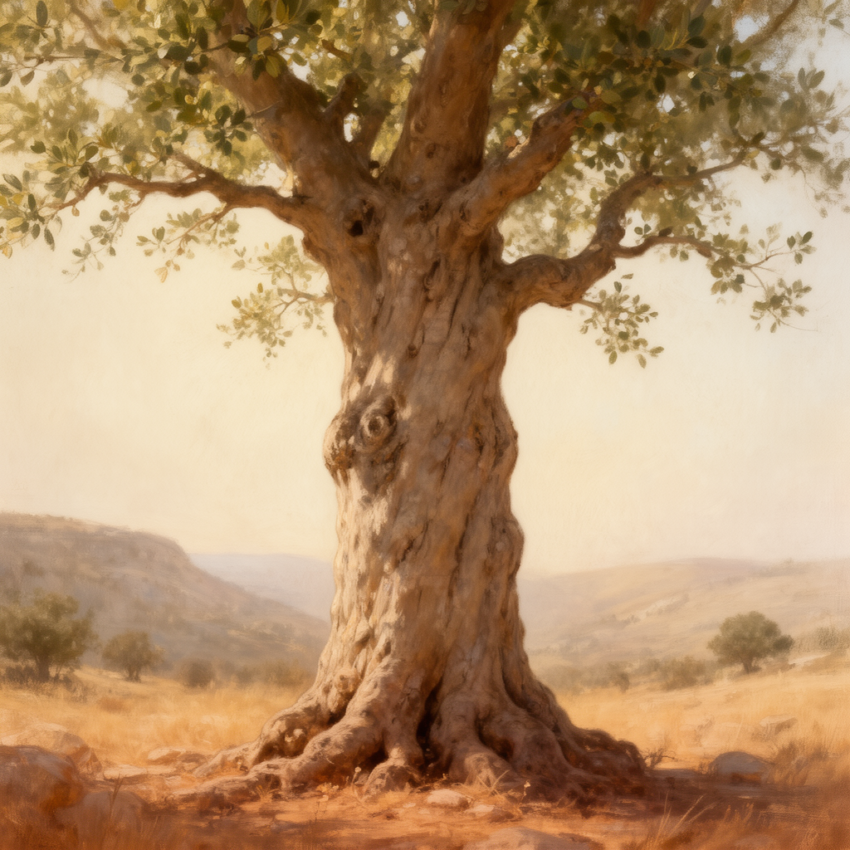
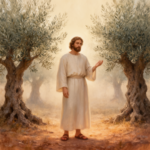
The terebinth is a small to medium deciduous tree reaching 3–8 meters in height. It has a gnarled, spreading canopy with dense, pinnate leaves comprising 5–9 leaflets, turning russet in autumn. The tree produces small, yellowish-green flowers in dense clusters during spring, which give way to resinous, bitter berries roughly 1 cm in diameter. Its bark is smooth in youth, becoming rough with age, often exhibiting a grayish-brown hue with patches of resin. Preferring rocky, well-drained soils, it thrives in Mediterranean climates with hot, dry summers and mild, wet winters, making it a common sight in upland areas, valleys, and ancient ruins.
Scientific Name
Debated: Pistacia palaestina or Pistacia terebinthus
Hebrew/Greek Name
אֵלָה (Eilah) / ἐλαία (Elaia)
Common Names
Terebinth, Palestinian Pistacia
Native Habitat
Native to the eastern Mediterranean region, including modern-day Israel, Palestine, Jordan, Lebanon, and Syria. It grows in rocky hillside areas, dry slopes, and scrublands, particularly on limestone and clay soils. The climate is characterized by hot, dry summers and cool, rainy winters, ideal for drought-tolerant trees like the terebinth.
First Biblical Mention
Genesis 21:33, when Abraham plants a terebinth in Beersheba.
📖 Biblical References
Reference
Context
Significance
1 Samuel 17:2-3
David and Goliath’s confrontation took place near the valley of Elah, where terebinth trees grew alongside the battlefield.
Symbolic of the ancient landscape where divine victory was achieved, highlighting the tree’s connection to divine providence and historical memory.
Judges 9:6
The terebinth was used as a marker for the leaders of Shechem during Abimelech’s rise to power.
Represents authority, territorial claims, and the enduring nature of divine and human covenants.
Genesis 21:33
Abraham planted a terebinth in Beersheba, where he called on the name of the Lord.
Serves as a spiritual symbol of covenant and divine blessing, rooted in the land and history.
The terebinth in biblical symbolism embodies resilience, divine blessing, and faithfulness. Its hardy nature reflects steadfastness and endurance amid adversity. Given its frequent mention in sacred contexts, it symbolizes God's covenant with Israel, divine protection, and the rootedness of faith in the land. Its resinous sap also alludes to purification and healing, representing spiritual restoration. The tree's enduring presence in archaeological and biblical sites underscores themes of stability, divine provision, and the sanctity of the land. As a pastoral emblem, the terebinth evokes protection over flocks and communities, signifying spiritual shelter and divine presence. Throughout Scripture, it reminds believers of God's faithfulness to His promises and the importance of establishing roots in spiritual and land-based covenants.
🏺 Cultural Uses in the Ancient World
Ancient Israelites utilized the terebinth for various purposes. Its resin was harvested for medicinal salves and incense, believed to have healing properties. Its wood, although hard and resinous, was used in constructing shelters, furniture, and altars due to its durability. The berries and leaves served as fodder for livestock, while the tree's shade provided refuge in hot environments. Symbolically, terebinth branches were used in rituals and as markers in sacred spaces. Its resin, known as turpentine, was traded across the region, emphasizing its economic and cultural significance. The tree also held symbolic value in narratives of divine blessing and territorial identity, often marking boundaries or sacred sites.
✡️ In Jewish Tradition
The terebinth is referenced in rabbinic literature as a symbol of strength and endurance. Its mention in the Talmud highlights its use in blessing and purification rituals, with its resin seen as a symbol of divine mercy. The tree’s association with Abraham’s planting in Beersheba emphasizes themes of covenant and divine promise. It also appears in Kabbalistic symbolism, representing spiritual stability and divine emanation. In Jewish festivals, the terebinth’s enduring nature embodies the resilience of the Jewish people and faith, inspiring customs that honor rootedness in divine law and tradition.
Christian interpretation often views the terebinth as a symbol of steadfast faith and divine providence. Its resilient nature resonates with the Christian call for perseverance amidst trials. The tree's biblical associations with Abraham, David, and sacred sites reinforce themes of divine blessing, covenant, and spiritual homeland. Some Christian traditions see the terebinth as a symbol of Christ’s strength and the spiritual shelter offered by faith. Its presence in sacred landscapes underscores the biblical message of divine faithfulness, serving as a reminder of the divine roots of salvation history and the importance of spiritual endurance.
🔬 Modern Botanical Identification
Scholars generally identify the biblical terebinth with Pistacia palaestina or Pistacia terebinthus, which are endemic to the region. While there is consensus on these candidates, some debate persists over the precise species, with variations in local distribution and botanical characteristics. The resinous nature and historical use align with these species, though archaeological evidence does not conclusively specify one over the other. Ongoing botanical and archaeological studies continue to refine its identification, but Pistacia terebinthus remains the most accepted candidate.
🗺️ Where Is It Found Today?
The terebinth grows widely in Israel and the Levant, often in rocky hills, old ruins, and nature reserves like the Yatir Forest in southern Israel. It thrives in Mediterranean climates and is cultivated ornamentally or preserved in conservation areas, especially in regions with similar conditions to biblical landscapes.
❓ Frequently Asked Questions
Is the terebinth the same as the oak?
No, the terebinth (Pistacia terebinthus) is a different genus from oaks (Quercus), though both are woody trees. The terebinth is resinous and smaller, while oaks tend to be larger with different leaf and bark characteristics.
What is the significance of the terebinth in biblical history?
The terebinth symbolizes divine covenant, faithfulness, and resilience. It’s associated with biblical figures like Abraham and David and marks sacred sites, emphasizing its spiritual and historical importance.
Can I see terebinth trees in modern Israel?
Yes, terebinth trees grow in many protected areas and ancient sites across Israel, especially in dry rocky regions and nature reserves, offering a tangible link to biblical landscapes.
✨ Did You Know?
The resin from the terebinth, known as natural turpentine, was used in ancient Egypt for embalming and religious rituals. Archaeological remains of terebinth wood and resin have been discovered in ancient sites, illustrating its long-standing cultural significance across civilizations.